
Welcome to ONGC Hazira Plant Intranet
OIL & NATURAL GAS CORPORATION LTD.
HAZIRA PLANT
Caustic wash unit
TABLE OF CONTENTS
Contents Page No.
1. INTRODUCTION
1.1 GENERAL
1.2 DESIGN BASIS
2. PROCESS
2.1 PROCESS DESCRIPTION
2.2 ABSORPTION MECHANISM
2.3 STORAGE
2.4 PROCESS FLOW DIAGRAM
2.5 CAUSTIC STORAGE DIAGRAM
2.6 EQUIPMENT DETAILS
2.7 UTILITIES
3. NORMAL OPERATION
3.1 NORMAL OPERATION OF UNIT
3.2 MONITORING
3.3 DRAINING PROCEDURES
3.4 EFFLUENT SUMMARY
4. PLANT SHUTDOWN PROCEDURE
4.1 PLANT SHUTDOWN (LONG DURATION)
5. PLANT START-UP PROCEDURE
5.1 GENERAL
5.2 INTRODUCTION OF LPG
6. PROPERTIES
6.1 PROPERTIES OF CAUSTIC SODA
6.2 POTENTIAL HEALTH EFFECTS
7. SAFETY
7.1 FIRST AID MEASURES
7.2 PERSONAL PROTECTIVE EQUIPMENT
Caustic wash unit
1. INTRODUCTION
1.1 GENERAL
Hazira Gas Processing Complex is a receiving point for South Basin Gas. It has a receiving terminal and processing facilities, which include gas sweetening & dehydration, Condensate fractionation, Dew Point Depression, Sulphur Recovery and associated off sites & utility systems. Sour condensate, received at the terminal contains significant quantity of propane and butane, which is recovered as LPG in the condensate fractionation units (CFU). The sour LPG from CFU contains H2S in the range of 20 to 80 ppm. The Caustic Wash Unit removes H2S from the sour LPG to bring down the H2S to less than 4ppm before being sent to storage. The unit is located in the off-sites area.
1.2 DESIGN BASIS
Caustic Wash Unit is designed to remove up to 100 ppm of H2S from sour LPG. About 6.9% by wt. of Caustic is used to remove H2S from sour LPG. The sweet LPG that comes out from Caustic Wash Unit containing less than 4 ppmH2S is routed to LPG spheres for storage.
The system consists of 5 identical trains (3 trains in Phase-I, one in Phase-II and one in Phase-IIIA). Each train can handle 40M3/hr of Sour LPG. Normally 4 trains will be operating with one train standby.
LEGEND OF VESSELS
PHASE | CAUSTIC WASH DRUM | SAND FILTER | FLASH DRUM | GRAPHICS |
I | 20 V 219A/B/C | 20X218 A/B/C | 20V218 A/B/C | LPG C/R |
II | 21 V 219 D | 21 X 218 D | 21 V 218 D | PH-2 C/R |
IIIA | 23 V 219 E | 23 X 218 E | 23 V 218 E | PH-3 C/R |
Note: For Phase-II, Tr-D flow and sand filter indication are available in LPG control room.
Caustic wash unit
2. PROCESS
2.1 PROCESS DESCRIPTION
The sour LPG passes through a caustic wash drum or the absorber (V-219), containing 100 Be (6.9 wt %) caustic solution. LPG enters the drum near its bottom and a distributor is provided for uniform mixing. LPG flows voluntarily through the absorber bed from the bottom to the top due to the difference in their specific gravities. After the wash LPG passes through a sand filter (X-218) to remove any caustic carryover.
When the caustic solution concentration goes down to about 5-wt %, approximately 2M3 of fresh solution is added after draining the similar amount of spent or old solution. This operation is carried out in running condition. The spent caustic is flashed in caustic flash drum (V-218) to remove any light hydrocarbon vapors dissolved in it. The hydrocarbon vapors are routed to the flare header. The sand filter can be back washed using service water.
2.2 ABSORPTION MECHANISM
H2S (g) + H2O <=> H2S (aq) (1)
H2S (aq) + NaOH <=> NaHS + H2O (2)
NaHS + NaOH <=> Na2S + H2O (3)
2.3 STORAGE
Two conical roof tanks each of 20M3 (20-T-214A/B) for caustic of fresh caustic (48-50%) and the other for preparing the desired solution (100 be or 10 wt %) by diluting with DM water.
Two caustic pumps (20-P-225A/B-one operating with one standby) of 10M3/hr each provided for unloading caustic from tankers into the storage tanks. The same pumps are used for preparation of caustic solution and for transferring the prepared solution to caustic wash drums of each of the 5 trains.
2.4 PROCESS FLOW DIAGRAM
2.5 CAUSTIC STORAGE DIAGRAM
2.6 EQUIPMENT DETAILS
Caustic wash unit
2.6 EQUIPMENT DETAILS OF CAUSTIC WASH UNIT
Sl.No. | Equipment Name | Tag No. | Design | Capacity | OD/ID | Length | |
Pr. | Temp | M3 | MM | MM | |||
1. | Caustic Flash Drum | V-218 | 6.0 | 65 | 1.2 | 900/884 | 1600 |
2. | Caustic Wash Drum | V-219 | 24.2 | 65 | 29.7 | 2408/2340 | 6100 |
3. | Sand Filter | X-218 | 24.2 | 65 | 17.2 | 2052/2108 | 7875 |
4. | Caustic Receipt Tank | T-214 A | Full of liquid | 65 | 20.0 | 3000 | 3000 |
5. | Caustic Dilution Tank | T-214 B | Full of liquid | 65 | 20.0 | 3000 | 3000 |
SAND SPECIFICATIONS
Mesh Size 8-16
Density 1600 kg/m3
Caustic wash unit
2.7 UTILITIES
CONSUMPTION RATE OF UTILITIES IN CWU
1) D.M Water: 60 T/month
2) Fuel Gas: 35 Kg/h (Flare Purge Gas at two points).
3) Utility L.P steam, Plant air, Service Water, and IG are used intermittently in negligible quantities. Major quantities are used only during the turnaround activities.
The quantities are for all the 5 trains of CWU
Caustic wash unit
3. NORMAL OPERATION
3.1 NORMAL OPERATION OF UNIT
LPG and Caustic forms different layers in the caustic wash drum, where the interphase level gauges are provided to monitor the interphase. LPG being lighter overflows to the sand filters through the 4-inch line.
Caustic Wash Drums are provided with a relief valve, 2-inch utility connection, a 2-inch vent connection, a common caustic filling and drain line and low/high interphase alarms at main control room.
When the caustic strength comes down as analyzed and reported by the quality control department, the spent caustic is routed to the caustic flash drum where the entrained hydrocarbon vapors are released and routed to the complex flare header and the spent caustic is routed to the spent caustic treatment plant.
Sand Filter contains sand bed, and a distributor for hydrocarbon. The vessel is provided with a level gauge, a vent, a drain, a utility connection and safety relief routed to the flare. Filtered LPG free of caustic solution would go to the LPG storage under the control of HICs located downstream of each filter.
Backwash of Sand Filter
Facilities to backwash the bed with service water is provided to remove the foreign particles and the overflow during backwashing is routed to caustic sewer. Water is to be drained from the bottom of the filter. Correct procedure for draining water from LPG vessels must be followed, the first gate valve should be fully opened and then the second globe valve to be slightly opened to allow water to come out. After draining the globe valve is to be closed first followed by gate valves.
Caustic Unloading
Caustic solution of 50% concentration is unloaded in Tank-A from tanker. Pump 225 A/B is used to transfer the solution from tanker to the tank.
Caustic wash unit
3.2 MONITORING
H2S IN LPG: LPG sample from sand filter outlet is analyzed daily once. Off-spec LPG with H2S exceeding 4 ppm may be attributed to the following:
1) Inadequate chemical reaction due to too low caustic concentration
2) Very low solution level in the absorber.
3) Flow rate exceeding the design flow rate.
Factors at serial no.2 & 3 contribute to too less retention time inside the absorber.
4) Chocking of the nozzles on the feed distributors resulting in channelisation of flow and hence solution surface area exposed to feed LPG will be less.
CAUSTIC CONCENTRATION IN ABSORBER: Samples of caustic solutions are collected from the Caustic Wash Drum sample point daily once for evaluation of caustic concentration (NaOH-%w/w). Concentration is to be maintained in the range of 4% to 7% as per the studies and recommendation by the Quality and Process Control Laboratory, ONGC, Hazira. Fresh make-up from Tank-B is to be done in case of low concentration after blow-down of the same volume from the caustic wash drum.
CAUSTIC CONCENTRATION IN TANK-B: The diluted caustic concentration, prepared by addition of DM water will to be maintained at 10-12% before make-up in any train. Sample of diluted caustic for analysis is to be collected after at least 30 minutes recirculation with the help of pumps 225A/B. Higher caustic concentration promotes increased salt formation causing deposition and chocking problems.
SALTS CONCENTRATION INSIDE ABSORBER: Salts that can accumulate in the absorber are predominantly sulphides and to a much lesser extent, carbonates, both generally in dissolved form. Salt concentration analysis is not done on a regular basis. But in case of frequent chocking problems in the sample and drain lines, salts concentration needs to be ascertained. Periodic blow-down is to done to contain the accumulation of salt content in the caustic solution.
Caustic wash unit
3.3 DRAINING PROCEDURES
For Spent Caustic
2) All spent caustic solution is to be drained through caustic flash drum only keeping flash drum vent open to flare.
3) Liquid is to be routed to spent caustic treatment plant.
LPG
1) After draining caustic solution drain LPG to flare via flash drum.
2) Carry out LPG slowly in order to vaporize all LPG.
Caution
1) Ensure vacuum is not created during draining.
2) Always ensure depressurization before draining.
3) Do not try to dechock drain line or valve with wire or rod if the system is under pressure.
4) Do not drain line with hammer or rod if the line is very cold as at low temperature the line may become brittle.
5) Inform control room before any draining.
UNLOADING FROM TANKERS
The following precautions have to be remembered:
a) Tankers, unless they are specifically meant for storage and transport of caustic soda solution, should be thoroughly cleaned of all extraneous matter before use.
b) During loading and unloading, the tanker should be braked and isolated against any movement.
c) While loading and unloading spurting should be avoided and as an additional precaution antisplash screens should be used.
d) Foremen should supervise work on tankers and only workers using approved type of personal protective equipment should be allowed to work.
e) Compressed air should not be used for loading or unloading the tank wagons but pumps or gravity method should be used.
f) All valves should be closed before disconnection.
g) When empty, all openings and valves should be properly closed and the tanker returned promptly.
h) Safety instruction should be painted on both sides of the tankers.
Caustic wash unit
3.4 EFFLUENT SUMMARY
Effluent from this plant are categorized as follows:
a) Liquid effluents comprising of spent caustic from vessels, process oily water, washings and storm water effluents.
b) Gaseous effluents from vessels and safety valve discharges.
LIQUID EFFLUENTS
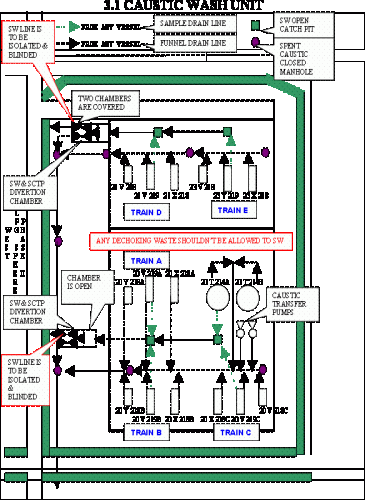
In normal operation, there will be periodic blow down of spent caustic from wash drum and during sample collection for caustic concentration. All the liquid effluents are to be routed to the spent caustic treatment plant. The diagram No: 3.1 show in detail the wastewater collection system in CWU with necessary instructions.
GASEOUS EFFLUENTS
In normal circumstances there will not be any gaseous effluents. However during upset conditions, safety valve discharges will occur. The gaseous effluent will be routed to offsite flare header.

Caustic wash unit
4. PLANT SHUTDOWN PROCEDURE
4.1 PLANNED SHUT-DOWN (LONG DURATION)
1) Close the feed inlet isolation valves and then close the HIC on the LPG product line from control room. Close the isolation valves on the product line and sand filter inlet line.
2) All the three vessels in the caustic wash unit should be drained off liquid hydrocarbon and the plant depressurized to flare before inerting them.
Caustic Wash Drum (V 219)
Drain caustic from V 219 via flash drum (V 218) keeping the PSV by-pass open on the V 218 top to flare open. Do not keep the V 218 drain line valve fully open and also ensure that this valve is smoothly operable. Once LPG starts coming from V 218 drain line close the drain valve and allow the LPG to go to the flare.
Open V 219 PSV by-pass valve and depressurize the vessel fully.
Once complete depressurizing is ensured, start steam purging of the vessel through any nozzle in the vessel. The contents of the vessel will be heated slowly and the residual LPG will be vaporized into the flare header through PSV by-pass. This ensures complete and safe removal of residual LPG.
Sand Filter (X 218)
Drain caustic via V 218 following the same procedure as mentioned for caustic wash drum.
Open X 218 PSV by-pass valve and depressurize the vessel fully.
Start steam purging as in V 219 to ensure complete removal of residual LPG.
Fill up water in the vessel and back flush it through the 2” line from top.
Caustic wash unit
Flash Drum (V 218)
Purge the vessel with steam to vaporize any residual LPG to the flare header.
3) Pressurize the entire unit with inert gas.
4) Depressurize the entire unit to flare system through all vent connections. Repeat steps 3 and 4 until hydrocarbon content is below 0.5% volume. Check hydrocarbon content in dead ends of pipes and ensure that hydrocarbon in liquid is blown through.
5) Close all connections to flare when all lines and equipment have been inertized.
6) Turn the spectacle blinds at battery limits to their closed position.
The caustic wash unit’s concerned train is now completely isolated and ready for maintenance and inspection. Maintenance personnel shall not enter any vessel unless it is water flushed several times to remove the residual caustic and purged with air to displace all inert gas.
The maintenance personnel will enter the vessels only after wearing the required personal protective equipment for the purpose of sand removal and cleaning.
Caustic wash unit
5. PLANT START-UP PROCEDURE
5.1 GENERAL
In case of start-up ascertain that all utilities are available in adequate supply, and that the fire water system is operating. It is assumed that all the vessels and lines are purged free of oxygen with inert gas and leak tested. Check that all vents and drains are closed. Check that all temporary blinds installed for hydro testing has been removed. Check that all spectacle blinds at battery limits are in open condition. Refer the pre-startup checklist in table 5.1 before lining up of feed.
5.2 INTRODUCTION OF LPG
1) Turn all spectacle blinds to correct position for normal operation. When turning the spectacle blinds, allow a small amount of inert gas to pass from the flange so as to prevent air from entering the equipment.
2) Line up sweet LPG slowly from the sand filter outlet by opening the isolation valves and the HIC.Pressurize the filter up to 5 kg/cm2 and carry out leak test thoroughly. All flanges and connections must be tested for leaks using soap solution.
3) Once the system is found tight, open the 4” gate valve on the outline from caustic wash drum to filter and pressurize the wash drum up to 5 kg/cm2.Also open the 4” gate valve at the bottom inlet to wash drum. Repeat leak test procedures for this vessel also till the entire system are found tight.
4) Now open the sand filter outlet valves again and pressurize the system slowly up to 9 kg/cm2. Repeat leak test procedures thoroughly until entire system is found tight.
5) Make up diluted caustic solution from tank-B to caustic wash drum through pump 225A/B, up to 50% level of the wash drum, as checked from the level gauges.
6) Line up sour LPG by opening the isolation valves in the inlet line. Caustic wash unit’s concerned train is now in line.
Caustic wash unit
6. PROPERTIES
6.1 PROPERTIES OF CAUSTIC SODA
Product Name Synonyms
Caustic Soda, 50% solution Liquid Caustic, Lye Solution,
Caustic Lye, Soda Lye
Chemical Formula Molecular Weight
NaOH 40.00
Appearance and Odour Specific Gravity
Colourless or slightly coloured, 50% Solution: 1.53@60 F
Clear or opaque;odourless
Vapour Pressure Boiling Point
50% Solution:6.3 mm Hg @ 104 F 50% Solution: 293 F(145 C)
Viscosity
The viscosity of 50% caustic soda increases rapidly when its temperature falls below 65 Deg.F(16 Deg.C)
Exposure Guidelines
OSHA: 2mg/m3 Ceiling
Immediately dangerous to life or health (IDLH): 10 mg/m3
6.2 POTENTIAL HEALTH EFFCTS
Inhalation
Breathing of mist is possible. Breathing this material is harmful and cause death. Harmful effects include burns and permanent damage to the airways, including the nose, throat and lungs.
Skin
Cause skin burns and permanent skin damage.
Caustic wash unit
Eyes
Causes burns and permanent injury to eye tissue. Can cause blindness.
Ingestion
Harmful effects include burns and permanent damage to the digestive tract, including the mouth, throat, stomach and intestines. Symptoms may include severe abdominal pain and vomiting of blood.
Signs and symptoms of exposure
Depending upon level and duration of exposure, other possible signs and symptoms from breathing, swallowing and contact of this material with the skin may include: irritation of the nose, throat, airways, and lungs with cough, sneezing, perforation of the nasal septum, and blindness.
Caustic wash unit
7. SAFETY
7.1 FIRST AID MEASURES
Inhalation
Remove individual to fresh air and get immediate medical attention. If breathing is difficult, give oxygen. If breathing stops give artificial respiration.
Skin
Immediately wash exposed skin with plenty of soap and water while removing contaminated clothing and shoes. Get immediate medical attention. Wash clothing before reuse.
Eyes
Hold the eyelids apart and flush the eye gently with a large amount of water for at least 15 minutes. Get immediate medical attention. Washing eyes within several seconds of contact is necessary.
Ingestion
Have person drink a glass of water immediately if able to swallow. Get medical attention immediately. Do not induce vomiting unless directed to do so by medical personnel. Never give anything by mouth to an unconscious person.
FIRE FIGHTING INSTRUCTIONS
Approach fire from upwind to avoid hazardous vapours. Use flooding quantities of water as fog or spray to keep fire-exposed containers cool.
7.2 PERSONAL PROTECTIVE EQUIPMENT
Eye and Face Protection
Wear chemical goggles. A face shield should be worn in addition to goggles where splashing or spraying is a possibility.
Head and Neck
Broad-brimmed alkali resistant hard hats.
Skin Protection
Wear chemical resistant clothing, boots and gloves, which are made of neoprene, PVC, or rubber. Always place pant legs over boots.
Respiratory Protection
Where concentrations exceed or are likely to exceed 2 mg/m3 use high efficiency particulate filter or self-contained breathing apparatus.